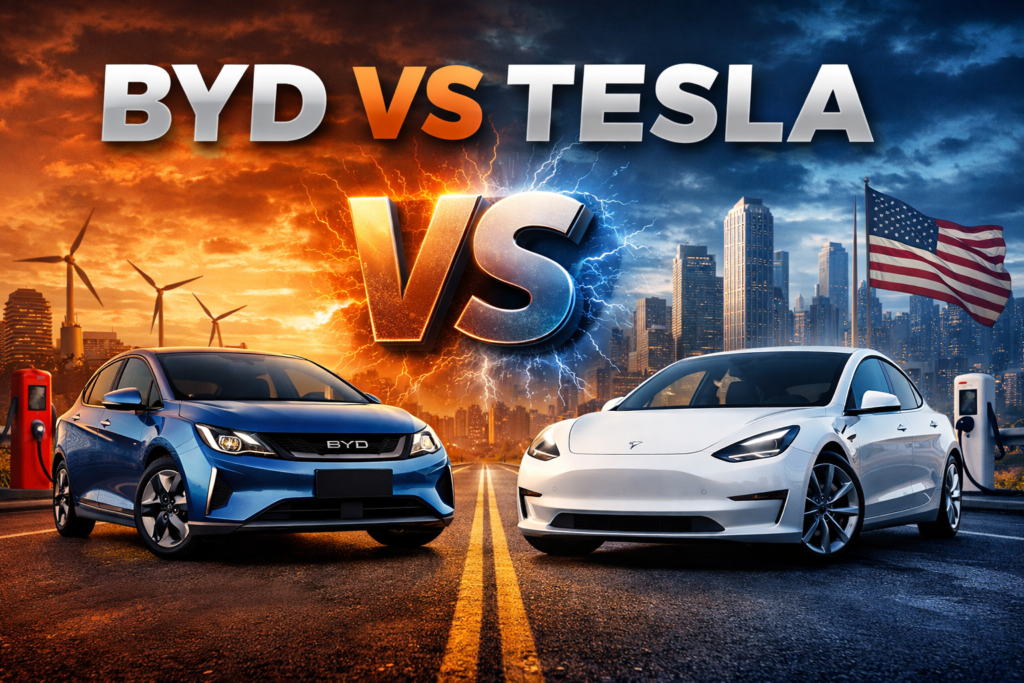
For years, it felt like Tesla sat alone at the top of the electric vehicle mountain. Then something shifted. A Chinese automaker many Americans had barely heard of — BYD — quietly scaled that same mountain, and suddenly the headlines read: BYD overtakes Tesla. The numbers aren’t hype. In recent quarters, BYD has sold more battery-electric cars globally than Tesla, signaling a real turning point in the EV industry. And while BYD isn’t yet selling passenger cars in the US, this shift still matters here — a lot. Let’s break down how BYD pulled this off, what Tesla is up against, and how this competition could reshape the US electric vehicle market in the years ahead.
The Rise of BYD: From Battery Maker to Global EV Leader
If Tesla was born in Silicon Valley swagger, BYD was built through quiet persistence. Founded in the mid-90s as a battery manufacturer, BYD spent years mastering cost-efficient lithium-ion production. That DNA matters — batteries are the single most expensive part of an EV.
Today, BYD stands for “Build Your Dreams”, and they’ve taken that slogan seriously. The company now produces:
- Electric sedans and SUVs
- Plug-in hybrids (PHEVs)
- Electric buses
- Electric trucks
- Batteries for other automakers
That last point is key. BYD doesn’t just assemble vehicles — they own the battery supply chain, including raw material partnerships, manufacturing tech, and in-house R&D. Their famous Blade Battery focuses on safety, durability, and cost efficiency — three things every EV buyer cares about.
This “vertical integration” lets BYD control costs in ways traditional automakers can’t easily match.
How BYD Overtakes Tesla: The Real Reasons Behind the Shift
There’s no single reason BYD overtakes Tesla in global EV sales — it’s a combination of strategy, timing, and market positioning.
1. BYD wins on price — without feeling cheap
While Tesla focused on mid-to-premium segments, BYD went after the mass market. Cars like the BYD Dolphin and BYD Seagull are priced aggressively compared to most EVs — sometimes even cheaper than gas cars.
This makes EV adoption easier for:
- First-time buyers
- Younger drivers
- Emerging-market consumers
- Budget-conscious families
Tesla has reduced prices over the past year, but BYD still operates with lower production costs. Battery expertise gives them a huge edge here.
2. China’s EV ecosystem is incredibly competitive
China is the largest EV market in the world, and it operates like the ultimate innovation lab. Consumers there have tons of electric choices — affordable, stylish, tech-packed cars with fast charging and strong range.
BYD didn’t just survive in that environment — it thrived.
Scale matters. Once you’re producing millions of vehicles, your per-unit cost drops. That scale helped BYD accelerate faster than legacy automakers struggling through EV transitions.
3. BYD plays both sides: EVs and plug-in hybrids
Unlike Tesla, BYD sells plug-in hybrids (PHEVs) alongside fully electric cars. In countries where charging infrastructure is still developing, PHEVs act as a useful bridge technology.
More models = more sales volume.
That’s helped fuel the narrative of BYD overtakes Tesla, even though Tesla remains all-in on battery-electric.
4. Localized manufacturing keeps costs down
BYD sets up factories closer to key markets — including massive expansion plans in Southeast Asia, Europe, and Latin America. Lower shipping costs and local jobs make regulators happy and customers confident.
Tesla does this too — but BYD is scaling rapidly.
Meanwhile, What’s Happening With Tesla?
Tesla isn’t failing. In fact, it’s still hugely profitable and incredibly influential. But the landscape around Tesla is changing fast.
Here’s what Tesla is dealing with:
- Increased competition
- A maturing EV market
- Slower consumer demand growth
- Greater price sensitivity
- Political polarization around EV adoption in the US
Tesla’s lineup is also fairly small compared to BYD’s. Right now, Tesla heavily relies on the:
- Model 3
- Model Y
- Model S
- Model X
- Cybertruck
Meanwhile, BYD offers dozens of models across different price points and lifestyles. More choices equal more customers.
That’s part of how BYD overtakes Tesla in sales volume — they’re playing a broader game.
What This Means for the US EV Market
Here’s the big twist: BYD doesn’t currently sell its passenger EVs in the US due to tariffs and political pressure. So why does this shift still matter?
Because competition doesn’t respect borders forever.
1. Expect more affordable EVs — from someone
As BYD proves that low-cost EVs can still be profitable, US automakers are under pressure to:
- Build cheaper entry-level EVs
- Improve supply chains
- Reduce battery costs
- Streamline manufacturing
Consumers win here. The EV price war is just beginning.
2. Policy discussions will heat up
Lawmakers are already debating how to protect US auto jobs while staying competitive in clean tech. You’ll likely hear more about:
- Tariffs on Chinese EVs
- Incentives for domestic EV manufacturing
- Battery sourcing rules
- Trade tensions
- National security concerns
The phrase “BYD overtakes Tesla” isn’t just business news — it’s geopolitical news.
3. Tesla may pivot — and innovate again
If history proves anything, it’s that Tesla doesn’t like being second.
That probably means:
- New model launches
- Lower-priced Tesla options
- Faster software evolution
- New battery tech
- Possibly more manufacturing locations
Healthy competition tends to speed up innovation. And the EV revolution is still in early chapters.
4. US consumers will become more EV-savvy
As global conversation shifts from “Will EVs succeed?” to “Which EV makes the most sense?”, shopping becomes more value-driven.
Consumers will start evaluating:
- Real-world range
- Charging convenience
- Total cost of ownership
- Resale value
- Software quality
- Battery longevity
And that benefits the brands that deliver — whether that’s Tesla, GM, Hyundai, Ford, or a future US-market BYD.
The Downsides and Risks Worth Noting
No story is one-sided. There are real concerns attached to this EV power shift:
- Trade tensions could escalate
- Supply chains still rely heavily on China
- EV charging infrastructure needs major upgrades in the US
- Affordability varies state-to-state
- Battery recycling must scale responsibly
Plus, brand trust matters — and Tesla has spent over a decade building it in the US. BYD still lacks recognition here.
Practical Takeaways for US Car Buyers
- Expect more EV choices
- Expect better prices over time
- Pay attention to battery tech and warranties
- Compare charging access in your area
- Don’t assume the most expensive EV is always best
Whether you lean toward Tesla or a different brand, the market is maturing — fast.
FAQs About Tesla, BYD, and the Future of EVs
Why did BYD overtake Tesla in global EV sales?
Mainly because BYD focuses on affordable, mass-market models and controls its battery supply chain. That combination keeps costs low while scaling fast.
Will BYD start selling cars in the US?
Right now, tariffs and policy barriers make it difficult. However, BYD does sell electric buses here — and future passenger entry isn’t impossible.
Is Tesla still the EV leader?
Tesla remains a leader in profitability, brand strength, and software innovation. But with BYD overtakes Tesla headlines circulating, it’s clear they now share the top tier.
Are BYD cars good quality?
Reviews across Europe and Asia generally say yes — especially for the price. BYD vehicles compete well on range, design, and interior tech.
What does this mean for EV prices in the US?
More competition typically lowers prices over time. US automakers are now racing to release lower-priced electric cars to keep up.
Final Thoughts: A Turning Point — Not the End of Tesla
The idea that BYD overtakes Tesla isn’t a story of one company falling and another rising. It’s a sign that electric vehicles are no longer niche. They’re entering the same competitive reality as smartphones, laptops, and every other mainstream technology market.
And competition is good.
It pushes companies to build better cars, lower prices, improve batteries, and think long-term about both innovation and sustainability. Whether you’re team Tesla, curious about BYD, or simply watching from the sidelines, one thing’s clear:
The global EV race just got a lot more interesting — and the US market is about to feel the ripple effects.
If you found this helpful, stick around and explore more insights on EVs, clean tech, and the future of transportation.